

Learning or Living? Both!
By Nick Allmaier
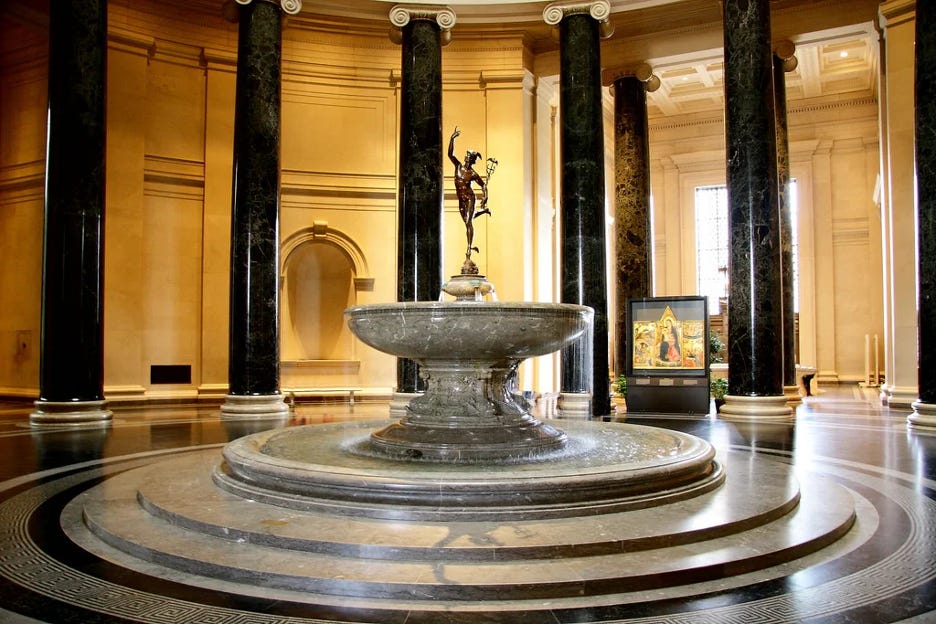
The year is 2012. A tall, cherubic man from New Jersey is listening to Beirut’s “Monna Pamona” at the National Gallery of Art in Washington, DC. His introduction to political theory class has just let out, and he rode the Metro down to let the ideas settle a bit in his soul. His head is swimming with the Portuguese verbs he had been memorizing—in line with a now disproven theory of grammar he’d been working on—the night before, using specialized “memory goggles” he developed in his father’s garage. It is an odd scene.
Gentle reader, I was that cherubic man. In retrospect there was something sweet and promising in my youthful eccentricity. If I met such a student now as a teacher, I would be overjoyed and amused.
I am now writing this post over a decade later from Washington, DC, where I have been helping to put on Lyceum’s first alumni event. It is a strange and happy coincidence of things that do not quite go together: returning to the place where I received my education while coordinating with others to reflect on their own. In addition to all this, I have been filming interviews for Lyceum’s upcoming video series, “The Good Lives,” which presents the stories of people who have spent their lives with the Great Books. And one of my interviewees is a teacher of mine.
A theme which ran through all my interviews, and many conversations besides, was that of the tension between a commitment to the books and a commitment to living life; to the universal and the particular; as my colleague John Pascarella put it, between the life of the Gentleman and the Philosopher. The tension runs like this: if I hold or sense that thinking through the problems—human problems—which the greatest authors present to me is the best use of my time, it is hard to understand how my attachment to the other things of my life can be justified. Why would I spend time watching the Ravens play football, or serving my country, or devoting myself to family life if Plato or Aristotle or Thomas or Kant is my only teacher, and learning my only vocation?
When I was young, this tension struck me as something of the profoundest importance, and my solution to it was to seek a profession in which the two, the universal and the particular, are at one. The university is the place that promises to unite them. And in its way, with many caveats, it does. But this does not solve the problem entirely, as life is larger and longer than a profession. What does one do when he goes home from teaching and thinking and reading? We look at the one who goes home only to continue thinking and reading with suspicion. Is this even a man, or some kind of god? Or better yet, does he fancy himself some kind of god?
As I’ve aged (and how I’ve aged!), the line between “time spent with the books” and “time spent with the ‘subphilosophic’ things” has become almost indistinguishable, and the tension has been almost entirely dissolved. This is owing in part to a gradual reconception of what philosophy, or “the life of the mind,” or the good life, is. This reconception did not take place solely in conversation with the books but in confrontations, willing and unwilling, with life, or the things I had deemed beneath serious engagement.
One way into this change is through Hamann’s cryptic lines from the Aesthetica:
“Speak, that I may see you!—This wish was fulfilled by creation, which is a speech to creatures through creatures; for day unto day utters speech, and night unto night shows knowledge. Its watchword traverses every clime to the end of the world, and its voice can be heard in every dialect.—The fault may lie where it will (outside or in us): all we have left in nature for our use are jumbled verses and disjecti membra poetae [‘limbs of the dismembered poet’].”
In the beginning, all things were speeches to man as man, but the postlapsarian world is a garbled text requiring interpretation. Hamann continues: “To gather these together is the scholar’s modest part; to interpret them, the philosopher’s; to imitate them—or bolder still—bring them into right order, the poet’s.”
Understand that I do not suppose that this account requires faith to be persuasive. Rather, I would say that one who has made an earnest attempt at the universal will inevitably find this understanding of things a live possibility, as I do now. What follows is, speaking for myself and not for Hamann (who I do not understand), a view of all things as in some way texts, or better, letters from the Author of things. Everywhere one finds riddles and teachings as (and perhaps more!) perplexing than those of Plato, riddles and teachings to and through which Plato the Poet attests and guides us in his philosophy. Imitation and right ordering of these may well be life’s work—a work that unifies the theoretical and practical, the universal and particular.